Every product shipped from one country to another starts with an exporter. Whether it’s textiles from India, electronics from China, or automobiles from Germany, the exporter is the business or individual responsible for sending those goods to an overseas buyer.
An exporter is more than just a seller—they coordinate with freight forwarders, Customs Brokers, shipping lines, banks, and transport companies to ensure the goods leave the country legally and reach the importer on time.
Who is an Exporter?
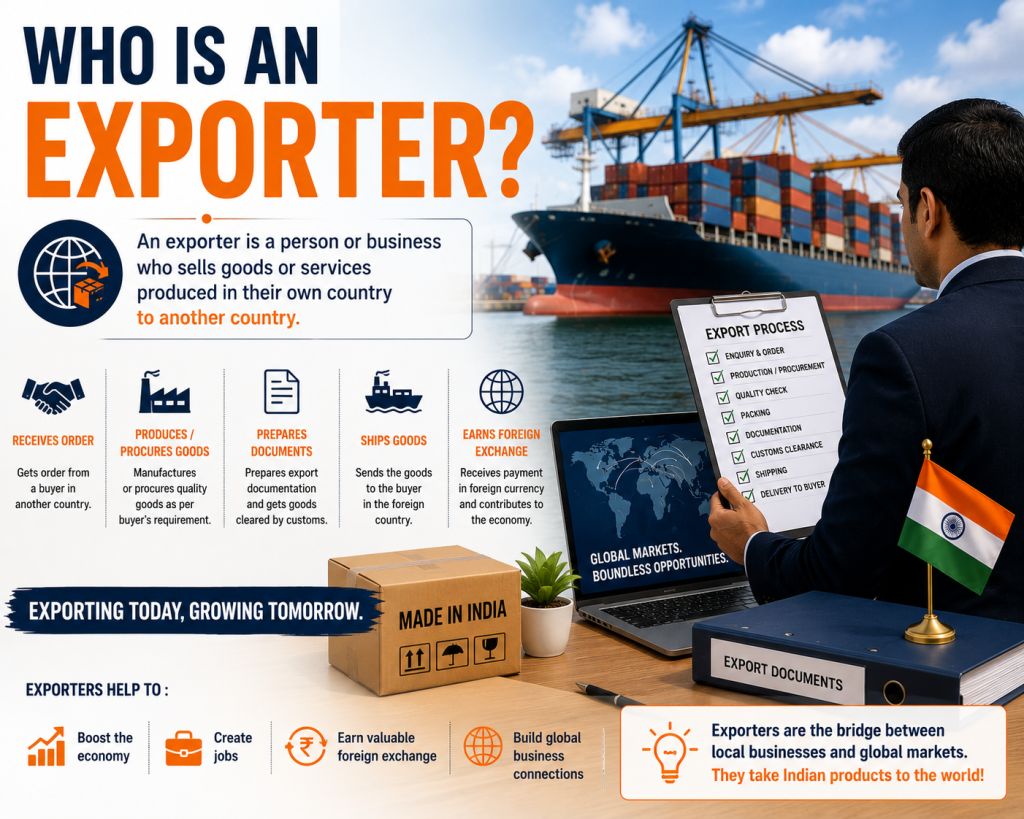
An exporter is an individual, company, manufacturer, or trader who sells goods to a buyer in another country.
For example:
- A textile manufacturer in India exporting garments to the USA.
- A pharmaceutical company exporting medicines to Africa.
- An automobile manufacturer exporting vehicles to Europe.
- A spice exporter shipping products to the Middle East.
The exporter is responsible for preparing the goods, completing export formalities, and ensuring the shipment is handed over to the carrier.
The Exporter: The Starting Point of the Shipment
The exporter initiates the international shipment. Once an overseas customer places an order, the exporter coordinates with multiple parties to move the cargo from their factory or warehouse to the destination country.
How Everyone is Connected
                      Overseas Buyer
                         (Importer)
                              ▲
                              │
                              │
                       📦 EXPORTER
                              │
      ┌───────────────────────┼────────────────────────┐
      │                       │                        │
      ▼                       ▼                        ▼
Freight Forwarder      Customs Broker             Bank
   (Logistics)           (CHA/CB)          (Payment/LC)
      │                       │
      ▼                       ▼
Shipping Line          Indian Customs
 / Airline                    │
      │                       │
      └──────────────┬────────┘
                     ▼
              Port / Airport
                     ▲
                     │
             Transport Company
                     ▲
                     │
          Exporter's Factory/Warehouse
The exporter coordinates all these parties to ensure the shipment leaves the country smoothly.
How an Exporter Coordinates with Different Parties
1. Overseas Buyer (Importer)
Everything begins when the overseas buyer places an order.
The exporter and importer agree on:
- Product specifications
- Quantity
- Price
- Payment terms
- Delivery terms (Incoterms)
- Shipment schedule
After the order is confirmed, production or packing begins.
2. Freight Forwarder
The exporter appoints a Freight Forwarder to organize the shipment.
The freight forwarder:
- Arranges pickup from the factory.
- Books space with the shipping line or airline.
- Plans the shipping route.
- Coordinates container stuffing.
- Issues shipping instructions.
- Monitors the shipment until destination.
The exporter usually communicates with the freight forwarder throughout the shipment.
3. Customs Broker (CHA)
Before the cargo can leave the country, export customs clearance must be completed.
The exporter provides documents such as:
- Commercial Invoice
- Packing List
- Purchase Order
- Export licenses (if applicable)
- Certificates required by the importing country
The Customs Broker:
- Files the Shipping Bill.
- Represents the exporter before Customs.
- Coordinates cargo examination if required.
- Obtains the Let Export Order (LEO).
- Completes customs formalities.
Without customs clearance, the shipment cannot be exported.
4. Shipping Line or Airline
After customs clearance, the cargo is loaded onto the vessel or aircraft.
The shipping line or airline transports the goods to the destination country.
The exporter normally communicates with the carrier through the freight forwarder.
5. Bank
The exporter works with their bank to:
- Receive international payments.
- Handle Letters of Credit (LC).
- Complete export banking formalities.
- Submit export documents where required.
6. Transport Company
The goods must first be transported from the factory or warehouse to the port, airport, or Container Freight Station (CFS).
This transportation is arranged either by the exporter or through the freight forwarder.
A Real-Life Example
Suppose a company in Mumbai exports engineering goods to Germany.
Here’s how the shipment moves:
- The Importer in Germany places an order.
- The Exporter manufactures and packs the goods.
- A Freight Forwarder arranges pickup and books space on a vessel.
- A Customs Broker (CHA) files the Shipping Bill and completes export customs clearance.
- The Shipping Line transports the container to Germany.
- The overseas Importer receives the cargo and completes import customs clearance in their country.
Throughout the process, the exporter coordinates all activities until the shipment is successfully dispatched.
Conclusion
An exporter is the person or business that sells goods to customers in another country and manages the export process from start to finish. They coordinate with freight forwarders, Customs Brokers, transport companies, shipping lines, banks, and Customs authorities to ensure the shipment leaves the country legally and reaches the overseas buyer.
Understanding the exporter’s role makes it easier to see how international trade works and how every party contributes to moving goods across borders.