If you’ve looked at a Bill of Lading (B/L), you may have noticed a field called “On Board Date” or “Shipped on Board Date.” This is one of the most important dates in international shipping.
In simple terms, the On Board Date is the date when the container or cargo is actually loaded onto the vessel. It confirms that the shipment has left the port of origin and has started its sea journey.
What is the On Board Date?
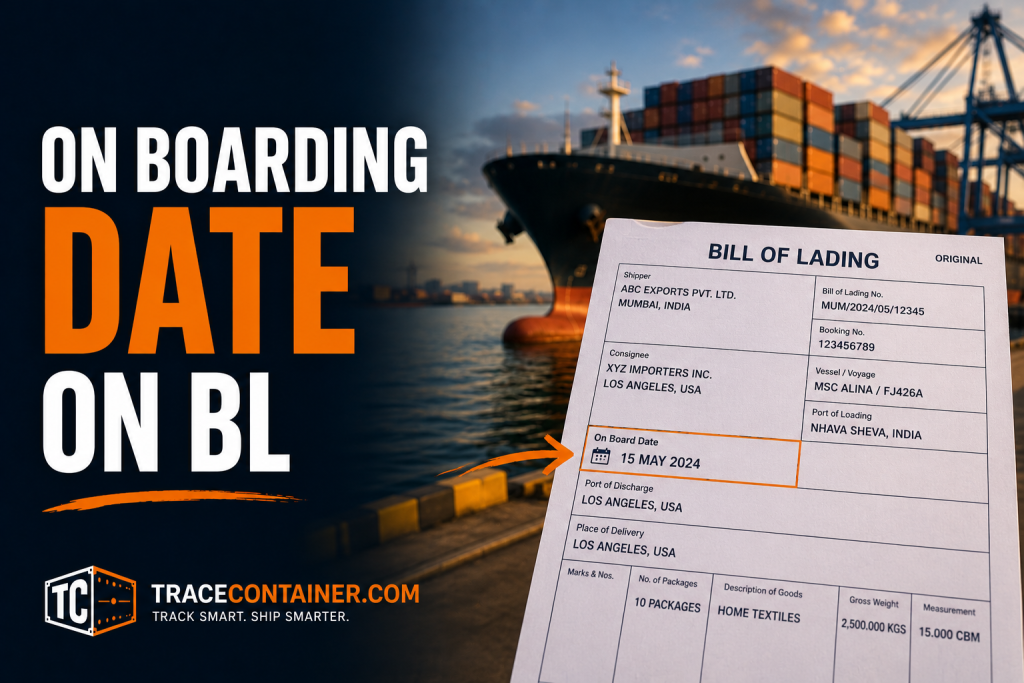
The On Board Date (also called the Shipped on Board Date) is the official date on which the shipping line confirms that the cargo has been loaded onto the vessel.
Once the cargo is on board, the shipping line issues or endorses the Bill of Lading with this date as proof that the shipment has been dispatched.
Think of it as the official departure date of your cargo by sea.
Why is the On Board Date Important?
The On Board Date is important for everyone involved in the shipment.
For Exporters, it:
- Confirms the goods were shipped on time.
- Serves as proof of shipment to the buyer.
- Is often required to receive payment under a Letter of Credit (LC).
For Importers, it:
- Helps estimate the vessel’s arrival date.
- Assists in planning customs clearance and warehouse operations.
- Allows better tracking of shipment progress.
For Banks, it:
- Verifies that the exporter complied with the shipping deadline mentioned in the Letter of Credit.
On Board Date vs Bill of Lading Issue Date
Many people confuse these two dates, but they are not always the same.
| Bill of Lading Issue Date | On Board Date |
|---|---|
| Date the Bill of Lading is issued by the shipping line or its agent | Date the cargo is physically loaded onto the vessel |
| May be before or after the vessel sails | Confirms the actual loading of cargo |
| Used for document issuance | Used as proof of shipment |
For example:
- Bill of Lading Issue Date: 10 July 2026
- On Board Date: 12 July 2026
This means the Bill of Lading was prepared on 10 July, but the container was actually loaded onto the vessel on 12 July.
Real-Life Example
Suppose an exporter in Mumbai ships auto parts to Germany.
The timeline may look like this:
- 5 July: Container reaches Nhava Sheva Port.
- 8 July: Shipping line prepares the Bill of Lading.
- 10 July: Container is loaded onto the vessel.
- 10 July: Bill of Lading is marked “Shipped on Board – 10 July 2026.”
- 11 July: Vessel departs for Hamburg.
Although the documents were prepared earlier, the On Board Date is 10 July, because that’s when the cargo was physically loaded onto the ship.
Where Can You Find the On Board Date?
On most Bills of Lading, the On Board Date appears near the carrier’s signature or stamp. It may be shown as:
- Shipped on Board
- On Board
- On Board Date
- Laden on Board
For example:
SHIPPED ON BOARD

Vessel: MSC IRINA
Voyage: 045W
On Board Date: 10-Jul-2026
Conclusion
The On Board Date is the official date when your cargo is loaded onto the vessel. It confirms that the shipment has begun its sea journey and serves as proof of shipment for importers, exporters, shipping lines, and banks.
Whether you’re tracking a container, planning customs clearance, or processing a Letter of Credit, the On Board Date is one of the first details you should check on a Bill of Lading.