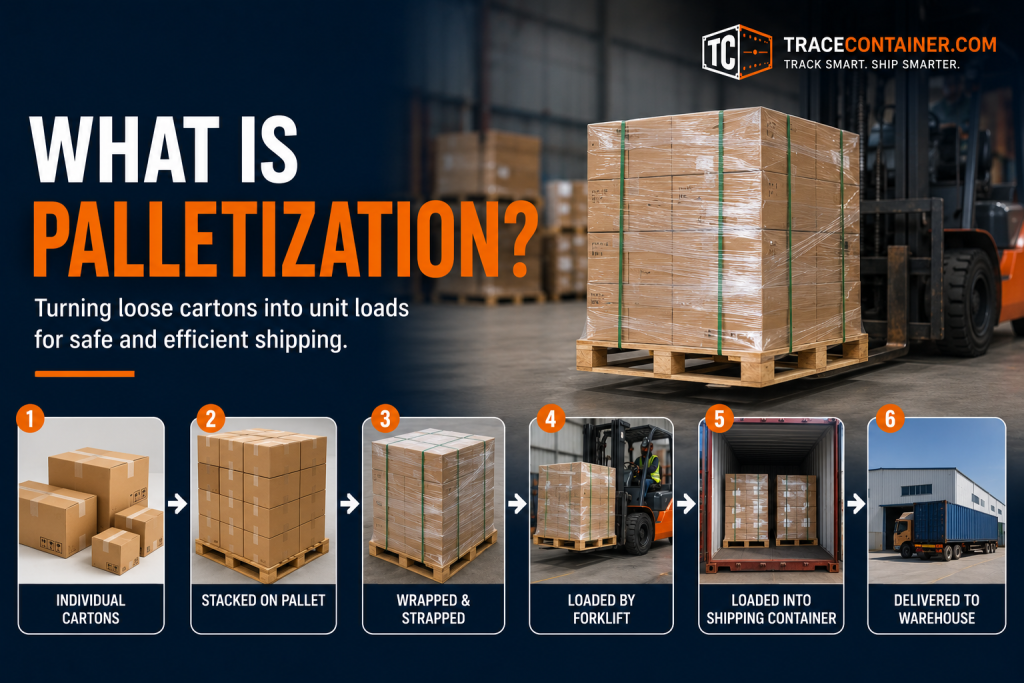
If you’ve ever seen stacks of boxes neatly placed on a wooden or plastic platform and moved using a forklift, you’ve already seen palletization in action.
Palletization is the process of placing goods on a pallet and securing them together as a single unit for easier handling, storage, and transportation.
Instead of moving hundreds of individual boxes, workers can move the entire pallet in one go using a forklift or pallet jack.
What is a Pallet?
A pallet is a flat platform, usually made of wood, plastic, or metal, that acts as a base for stacking goods.
Once the cargo is arranged on the pallet, it is typically secured using:
- Stretch wrap
- Shrink wrap
- Plastic or steel straps
- Corner protectors
This keeps the cargo stable throughout its journey.
What is Palletization?
Palletization is the process of arranging cartons, bags, drums, or other packages onto a pallet to create a single, secure load.
Instead of handling every package individually, the entire pallet is treated as one shipment unit.
This makes loading, unloading, and warehouse operations much faster and safer.
Why is Palletization Important?
Palletization offers several advantages throughout the supply chain.
1. Faster Loading and Unloading
A forklift can lift an entire pallet within seconds.
Without palletization, workers would need to load or unload each carton manually, which takes significantly more time.
2. Reduces Cargo Damage
Properly palletized cargo is more stable during transportation.
Stretch wrapping and strapping help prevent cartons from shifting, falling, or getting crushed inside the container.
3. Improves Warehouse Efficiency
Warehouses can stack and store palletized cargo more efficiently.
Since pallets have standard sizes, they fit easily into warehouse racks and make inventory handling more organized.
4. Saves Labor Costs
Moving one pallet is much quicker than moving dozens of individual packages.
This reduces manual handling and increases productivity.
5. Makes Transportation Safer
Forklifts and pallet jacks can safely move heavy loads that would otherwise require multiple workers.
This reduces the risk of workplace injuries.
Real-Life Example
Suppose a company exports 500 cartons of packaged food from India to the UAE.
Instead of loading 500 individual cartons into the container, they:
- Stack 50 cartons on each pallet.
- Wrap each pallet with stretch film.
- Secure the load using plastic straps.
- Use a forklift to load the pallets into the container.
Now, only 10 pallets need to be handled instead of 500 separate cartons.
The shipment is loaded faster, remains more secure during transit, and is easier for the importer to unload.
Common Types of Pallets
The most commonly used pallets are:
- Wooden Pallets – Most widely used and cost-effective.
- Plastic Pallets – Durable, lightweight, and resistant to moisture.
- Metal Pallets – Used for heavy industrial cargo.
- Paper/Cardboard Pallets – Lightweight and suitable for air freight.
For international shipments, wooden pallets must often comply with ISPM 15 regulations, which require heat treatment or fumigation to prevent the spread of pests between countries.
Palletization vs Containerization
Many beginners confuse these two terms.
| Palletization | Containerization |
|---|---|
| Goods are stacked on a pallet | Goods are loaded into a shipping container |
| Makes handling easier | Makes international transportation easier |
| Uses forklifts and pallet jacks | Uses containers transported by trucks, trains, and ships |
| Common in warehouses | Common in global shipping |
A shipment is often palletized first and then loaded into a shipping container for export.
Conclusion
Palletization is the process of placing goods on pallets to make them easier, safer, and faster to handle throughout the supply chain. It reduces cargo damage, improves warehouse efficiency, lowers labor costs, and speeds up loading and unloading operations.
Whether goods are transported by truck, air, or sea, palletization has become a standard practice in modern logistics and international trade.
What is Palletization? Meaning, Benefits & Examples Explained
If you’ve ever seen stacks of boxes neatly placed on a wooden or plastic platform and moved using a forklift, you’ve already seen palletization in action.
Palletization is the process of placing goods on a pallet and securing them together as a single unit for easier handling, storage, and transportation.
Instead of moving hundreds of individual boxes, workers can move the entire pallet in one go using a forklift or pallet jack.
What is a Pallet?
A pallet is a flat platform, usually made of wood, plastic, or metal, that acts as a base for stacking goods.
Once the cargo is arranged on the pallet, it is typically secured using:
- Stretch wrap
- Shrink wrap
- Plastic or steel straps
- Corner protectors
This keeps the cargo stable throughout its journey.
What is Palletization?
Palletization is the process of arranging cartons, bags, drums, or other packages onto a pallet to create a single, secure load.
Instead of handling every package individually, the entire pallet is treated as one shipment unit.
This makes loading, unloading, and warehouse operations much faster and safer.
Why is Palletization Important?
Palletization offers several advantages throughout the supply chain.
1. Faster Loading and Unloading
A forklift can lift an entire pallet within seconds.
Without palletization, workers would need to load or unload each carton manually, which takes significantly more time.
2. Reduces Cargo Damage
Properly palletized cargo is more stable during transportation.
Stretch wrapping and strapping help prevent cartons from shifting, falling, or getting crushed inside the container.
3. Improves Warehouse Efficiency
Warehouses can stack and store palletized cargo more efficiently.
Since pallets have standard sizes, they fit easily into warehouse racks and make inventory handling more organized.
4. Saves Labor Costs
Moving one pallet is much quicker than moving dozens of individual packages.
This reduces manual handling and increases productivity.
5. Makes Transportation Safer
Forklifts and pallet jacks can safely move heavy loads that would otherwise require multiple workers.
This reduces the risk of workplace injuries.
Real-Life Example
Suppose a company exports 500 cartons of packaged food from India to the UAE.
Instead of loading 500 individual cartons into the container, they:
- Stack 50 cartons on each pallet.
- Wrap each pallet with stretch film.
- Secure the load using plastic straps.
- Use a forklift to load the pallets into the container.
Now, only 10 pallets need to be handled instead of 500 separate cartons.
The shipment is loaded faster, remains more secure during transit, and is easier for the importer to unload.
Common Types of Pallets
The most commonly used pallets are:
- Wooden Pallets – Most widely used and cost-effective.
- Plastic Pallets – Durable, lightweight, and resistant to moisture.
- Metal Pallets – Used for heavy industrial cargo.
- Paper/Cardboard Pallets – Lightweight and suitable for air freight.
For international shipments, wooden pallets must often comply with ISPM 15 regulations, which require heat treatment or fumigation to prevent the spread of pests between countries.
Palletization vs Containerization
Many beginners confuse these two terms.
| Palletization | Containerization |
|---|---|
| Goods are stacked on a pallet | Goods are loaded into a shipping container |
| Makes handling easier | Makes international transportation easier |
| Uses forklifts and pallet jacks | Uses containers transported by trucks, trains, and ships |
| Common in warehouses | Common in global shipping |
A shipment is often palletized first and then loaded into a shipping container for export.
Conclusion
Palletization is the process of placing goods on pallets to make them easier, safer, and faster to handle throughout the supply chain. It reduces cargo damage, improves warehouse efficiency, lowers labor costs, and speeds up loading and unloading operations.
Whether goods are transported by truck, air, or sea, palletization has become a standard practice in modern logistics and international trade.