When booking a large shipment, deciding on a 40-foot setup seems straightforward. But then you encounter a choice that confuses many logistics newcomers: Should you use a 40ft Standard container or a 40ft High Cube (40HC) container?
At first glance, they look almost identical. They take up the exact same footprint on a ship, train, or truck. However, making the wrong choice can either leave your cargo stranded on the loading dock or force you to pay for empty space you do not need.
Here is the simple breakdown of how a single foot of height changes everything in container economics.
The Core Difference: The Footprint vs. The Height
The simplest way to understand these two choices is through their external measurements:
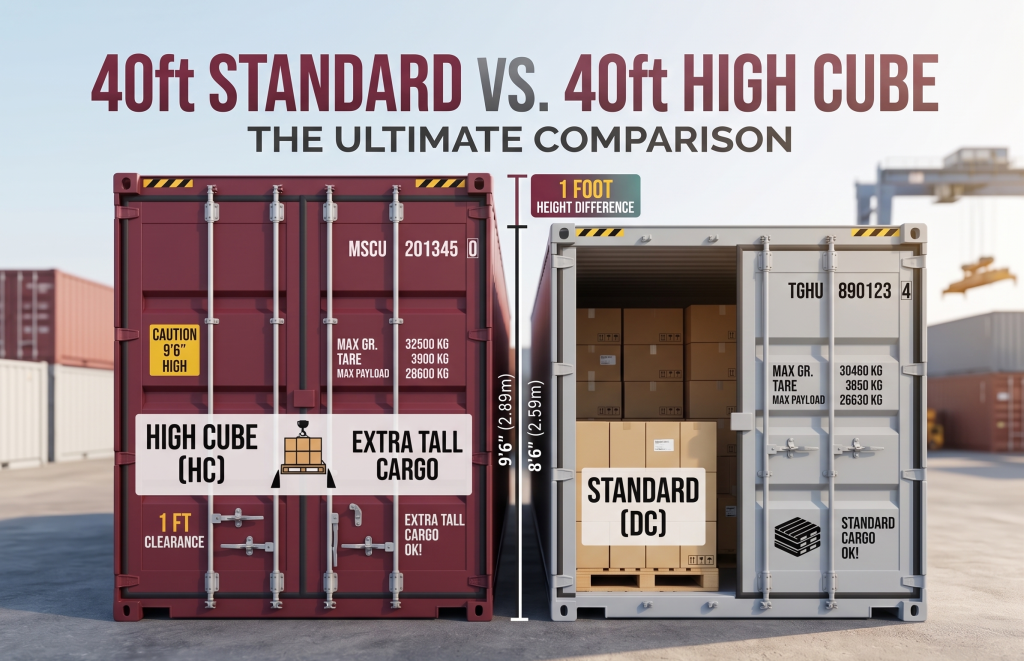
- What stays the same: Their length and width are identical. Both containers are 40 feet long (~12.19 meters) and 8 feet wide (~2.44 meters).
- What changes: The vertical clearance. The High Cube container gives you exactly 1 extra foot (12 inches) of vertical space.
Key Physical Dimensions At a Glance
Because corrugated steel walls and wood flooring eat up a bit of space, the room you get on the inside is slightly smaller than the outside dimensions. Here is how they stack up side-by-side:
| Dimension | 40ft Standard Container | 40ft High Cube (40HC) | The Difference |
| External Height | 8 ft 6 in (~2.59 m) | 9 ft 6 in (~2.90 m) | + 1 foot |
| Internal Height | 7 ft 10 in (~2.39 m) | 8 ft 10 in (~2.69 m) | + 1 foot |
| Internal Volume | ~2,389 cu ft (~67.7 m³) | ~2,694 cu ft (~76.4 m³) | + 13% more space |
The Volume vs. Weight Paradox (The Payload Trap)
This extra foot of height provides roughly 305 extra cubic feet of volume, creating 13% more internal room. Naturally, you might think, “Great! I can pack 13% more weight inside the High Cube.”
This is a common misconception.
Both containers share the exact same Maximum Gross Weight limit under international ISO standards—usually around 30,480 kg (67,200 lbs). This is the absolute maximum weight allowed for the container plus the cargo inside.
- Because a High Cube is physically taller, it requires more steel to build, making its Tare Weight (the weight of the empty box) slightly heavier by a few hundred kilograms.
- As a result, the Net Payload capacity (the actual weight of the goods you can legally put inside) is actually slightly lower in a High Cube than in a Standard 40ft container.
When to Use Which: The Logistics Strategy
Choosing between them comes down to a classic shipping concept: Are your goods going to “Weigh Out” or “Cube Out”?
Scenario A: Choose the 40ft Standard (For Heavy Cargo)
Use this box when your cargo is dense and heavy. You will hit the maximum legal weight limit long before you fill up the physical space of the container.
- Best For: Industrial machinery, steel coils, marble tiles, stone blocks, heavy copper components, or barrels of liquids.
- Why: If your cargo fills only half the height of a standard container before hitting 26,000 kg, paying extra for a High Cube means you are paying to ship empty air.
Scenario B: Choose the 40ft High Cube (For Bulky Cargo)
Use this box when your cargo is lightweight but takes up massive amounts of physical room. You will run out of space long before you hit the legal weight limit.
- Best For: Retail garments, textiles, footwear, toys, electronics, furniture, or large, unstackable cartons.
- Why: That extra foot of height allows you to stack an entire additional layer of cartons or pallets, maximizing your “cost per cubic meter.”
Summary: 40ft vs 40ft High Cube Container
Think of these containers as two boxes with the exact same floor plan, but one has a higher ceiling. If you are shipping heavy steel, keep it standard. If you are shipping voluminous consumer merchandise, always upgrade to the High Cube.
No matter which configuration you choose for your global shipments, you can monitor their ocean voyages and port milestones seamlessly by entering your container code into TraceContainer.com.