If you’re new to the shipping industry, one of the first things you’ll notice is that every container has a unique code stamped on its side, something like MSCU 123456 7 or HLXU 890123 4. These aren’t random. Every letter, every digit means something specific.
This guide breaks down how container numbers work, who decides them, what BIC codes are, and gives you real container number examples from every major shipping line — all in a beginner-friendly way.

What Is a Container Number?
A container number (also called a container ID or container code) is a standardized alphanumeric code used to uniquely identify every single shipping container in the world.
A container number example looks like this:
M S C U   1 2 3 4 5 6   7
[---]  [------]  [-]
Owner  Serial    Check
Prefix  Number   Digit
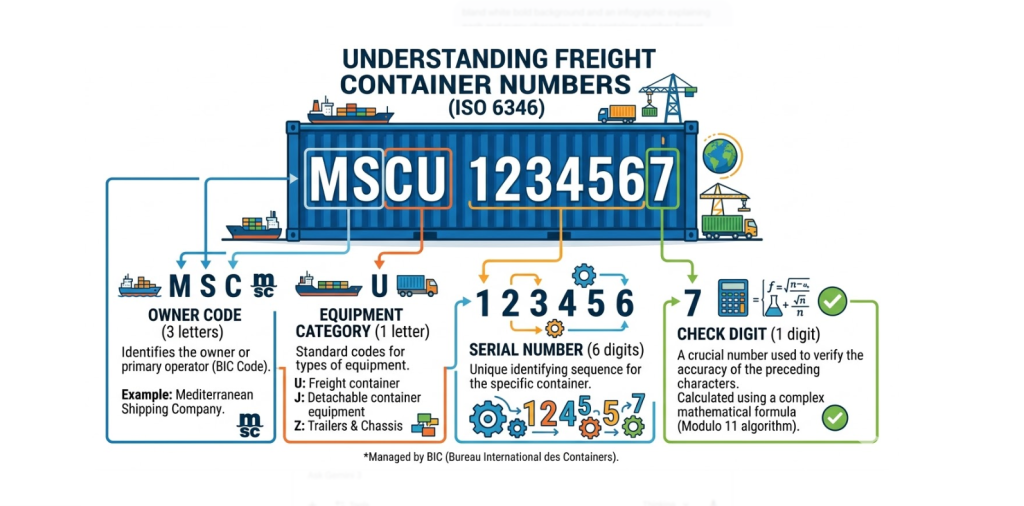
Every container number follows this exact format, no exceptions:
- 4 letters (Owner Code + Equipment Category Identifier)
- 6 numbers (Serial Number)
- 1 check digit (Validation number)
Total: 4 letters + 6 digits + 1 check digit = 11 characters
Who Decides Container Numbers? (The BIC System Explained)
What Is BIC?
BIC stands for Bureau International des Containers et du Transport Intermodal — or in English, the International Container Bureau.
BIC is a non-profit, intergovernmental organization based in Paris, France. It was founded in 1933 and is the official body responsible for registering container owner codes (called BIC Codes) worldwide.
Think of BIC as the “DMV for containers.” Just like a car gets a unique license plate registered with a government agency, every shipping company must register a unique 3-letter owner code with BIC.
How the BIC Code Registration Works
- A shipping company applies to BIC for a unique 3-letter owner code
- BIC verifies the code is not already taken
- The code is officially registered in the BIC database
- The shipping company must then use this code as the first 3 characters on ALL their containers
Official BIC Registry: You can look up any registered owner code at www.bic-code.org
Breaking Down a Container Number — Part by Part
Let’s use a real container number example to explain each part:
Example: MSCU 123456 7
Part 1: Owner Code (First 3 Letters) = MSC
This is the 3-letter BIC-registered prefix that identifies the owner or operator of the container.
MSC= Mediterranean Shipping CompanyMAE= Maersk LineHLXUprefix = Hapag-Lloyd
Every shipping company has its own registered prefix. No two companies can have the same 3-letter code.
Part 2: Equipment Category Identifier (4th Letter) = U
The 4th letter tells you what type of equipment the container is.
| Letter | Meaning |
|---|---|
| U | Freight Container (most common) |
| J | Detachable freight container-related equipment |
| Z | Trailers and chassis |
Almost every standard container you’ll encounter uses U. So in most container number examples you’ll see online, the 4th character is always “U.”
Part 3: Serial Number (6 Digits) = 123456
This is a unique 6-digit number assigned by the container owner. It helps them track individual containers within their own fleet.
- Numbers range from
000000to999999 - The owner assigns them internally
- No two containers from the same company will share a serial number
Part 4: Check Digit (Last Number) = 7
The check digit is a calculated validation number (0–9) that confirms the rest of the container number is correct and hasn’t been misread or mistyped.
It’s calculated using a specific mathematical formula involving the values of all previous characters. Scanners and software use this to instantly verify if a container number is valid.
Beginner Tip: You don’t need to calculate the check digit manually. Online tools can do it for you — but the key point is that if someone writes a wrong container number, the check digit will catch the mistake.
Container Number Examples from Every Major Shipping Line
Below is a comprehensive table of the world’s biggest shipping lines, their official BIC-registered owner prefixes, and realistic container number examples for each.
Note: The serial numbers used in examples below are for illustration purposes only and are formatted to show how a real container number looks. Actual container assignments vary by fleet.
Top 10 Global Shipping Lines — Container Number Examples
| Shipping Line | Country | Owner Prefix | Container Number Example | Fleet Size (approx.) |
|---|---|---|---|---|
| MSC (Mediterranean Shipping Company) | Switzerland/Italy | MSCU | MSCU 234781 6 | 6,700+ vessels |
| Maersk Line | Denmark | MAEU | MAEU 891234 5 | 700+ vessels |
| CMA CGM | France | CMAU | CMAU 347821 3 | 600+ vessels |
| COSCO Shipping | China | CSNU | CSNU 123789 0 | 500+ vessels |
| Hapag-Lloyd | Germany | HLXU | HLXU 678912 4 | 250+ vessels |
| Evergreen Line | Taiwan | EISU | EISU 452317 8 | 200+ vessels |
| Yang Ming | Taiwan | YMLU | YMLU 891045 2 | 100+ vessels |
| ONE (Ocean Network Express) | Japan | ONEY (containers) / ONEU | ONEU 567234 1 | 200+ vessels |
| HMM (Hyundai Merchant Marine) | South Korea | HDMU | HDMU 234567 9 | 70+ vessels |
| PIL (Pacific International Lines) | Singapore | PCIU | PCIU 789123 6 | 80+ vessels |
Regional & Specialty Shipping Lines — Container Number Examples
| Shipping Line | Region | Owner Prefix | Container Number Example |
|---|---|---|---|
| Zim Integrated Shipping | Israel | ZIMU | ZIMU 345678 2 |
| Wan Hai Lines | Taiwan | WHLU | WHLU 123456 8 |
| OOCL (Orient Overseas Container Line) | Hong Kong | OOLU | OOLU 891234 7 |
| MOL (Mitsui OSK Lines) | Japan | MOLU | MOLU 456789 3 |
| NYK Line | Japan | NYKU | NYKU 234891 5 |
| K Line (Kawasaki Kisen) | Japan | KKTU | KKTU 678901 4 |
| UASC (United Arab Shipping Company) | UAE | UACU | UACU 901234 6 |
| Arkas Line | Turkey | ARKU | ARKU 123789 1 |
| Sinokor Merchant Marine | South Korea | SKHU | SKHU 456012 9 |
| KMTC (Korea Marine Transport Co.) | South Korea | KMTU | KMTU 789345 2 |
| Samudera Shipping | Indonesia | SMDU | SMDU 234678 0 |
| Swire Shipping | UK/HK | CHVU | CHVU 890123 7 |
| Gold Star Line | Hong Kong | GSLU | GSLU 567890 3 |
| TS Lines | Taiwan | TSLU | TSLU 123456 5 |
| SITC Container Lines | China | SITV | SITV 678234 8 |
Container Leasing Companies — Container Number Examples
Many containers are not owned by shipping lines — they are leased from container leasing companies. These companies also have BIC-registered prefixes.
| Leasing Company | Owner Prefix | Container Number Example |
|---|---|---|
| Triton International | TRLU | TRLU 891234 6 |
| Florens Container | FCIU | FCIU 456789 1 |
| Textainer | TGHU | TGHU 234567 8 |
| CAI International | CAXU | CAXU 678912 3 |
| SeaCastle | SCZU | SCZU 901234 5 |
| Gold Container | GCXU | GCXU 345678 7 |
Beginner Tip: Just because a container has “MSCU” on the side doesn’t mean MSC owns it. They may have leased it from a company like Triton. The prefix tells you the registered owner, which is sometimes different from the operating carrier.

How Container Numbers Are Assigned — Step by Step
Here’s how the whole system works from start to finish:
Step 1 — Company registers with BIC A shipping company pays a registration fee and applies for a unique 3-letter owner code from BIC.
Step 2 — BIC approves the code BIC checks their global registry to make sure the code isn’t taken, then approves and registers it.
Step 3 — Company builds or leases containers When new containers are manufactured or leased, the company assigns a 6-digit serial number to each one.
Step 4 — Check digit is calculated Using the ISO 6346 standard formula, a check digit (0–9) is calculated based on the letters and numbers in the container ID.
Step 5 — Code is stamped on the container The full container number is physically stenciled or painted on the container — typically on the door, left side, and right side panels.
Step 6 — Container enters global tracking systems Shipping lines, ports, and freight forwarders enter the container number into digital systems where it can be tracked worldwide.
ISO 6346 — The International Standard
All container numbering follows ISO 6346, a standard published by the International Organization for Standardization (ISO).
ISO 6346 defines:
- The format of the container identification code
- The system for assigning owner codes
- The method for calculating check digits
- How the code should be displayed on the container
This means that no matter which country you’re in or which shipping line you’re dealing with, every container number follows the same universal format. A container number example from a Chinese carrier follows the exact same structure as one from a Danish or Swiss carrier.
🌐 You Don’t Need to Memorize Every Prefix — Just Use TraceContainer
Here’s the honest truth: there are thousands of registered BIC owner codes. Nobody in the shipping industry memorizes them all — not freight forwarders, not port agents, not customs officers.
What everyone actually does is use a container tracking tool.
TraceContainer.com is one of the most beginner-friendly ways to track any container from any shipping line. Instead of having to know which carrier a container belongs to, which system to log into, or what prefix stands for which company — you just:
- Type the container number (e.g.,
MSCU 234781 6) - Hit search
- See the live tracking status, vessel name, port of origin, destination, and ETA
TraceContainer automatically recognizes the owner prefix, identifies the shipping line, and pulls the tracking data — so you don’t need to keep a cheat sheet of every shipping line’s prefix.
Whether it’s Maersk, MSC, CMA CGM, Evergreen, or any of the hundreds of smaller regional carriers, TraceContainer handles the lookup for you.
Beginner Tip: Bookmark TraceContainer.com as your go-to container tracking tool. It saves you the frustration of going to 10 different carrier websites trying to figure out who owns a container.
Quick Recap — Container Number Cheat Sheet for Beginners
| Concept | Quick Explanation |
|---|---|
| Container Number | Unique 11-character ID on every container |
| Format | 4 letters + 6 digits + 1 check digit |
| Owner Code (first 3 letters) | Identifies the registered container owner |
| 4th Letter | Almost always “U” (freight container) |
| 6-digit serial | Assigned by the owner to track their fleet |
| Check digit | Math-calculated digit to validate the number |
| Who registers prefixes? | BIC (Bureau International des Containers) |
| International Standard | ISO 6346 |
| Best way to track any container | TraceContainer.com |
Frequently Asked Questions
Q: Can two containers have the same number? No. Each container number is globally unique. The combination of owner prefix + serial number + check digit ensures no two containers in the world have the same ID.
Q: What if the 4th letter is not “U”? If you see a “Z” or “J” as the 4th character, it refers to trailer chassis or other container-related equipment — not a standard freight container.
Q: Do container numbers ever change? The number is physically on the container, so it stays the same throughout the container’s life. However, if a container is sold to a new owner, it may be re-marked with a new owner prefix.
Q: Why are some container numbers shown without a space? Both formats are the same thing. MSCU1234567 and MSCU 123456 7 refer to the same container. The spaces are just added for readability.
Q: Is BIC registration mandatory? Yes, for any company wanting their containers to be recognized globally under ISO 6346, BIC registration is required. It’s the only internationally recognized registry for container owner codes.
Last updated for accuracy. All container number examples in this article are illustrative samples following the ISO 6346 standard format. For live container tracking, visit TraceContainer.com.